Sweden's 2026 Election & the Labour Market: What All 8 Parties Propose for Your Career and Finances
Introduction: The Labour Market at the Center of Sweden's 2026 Election
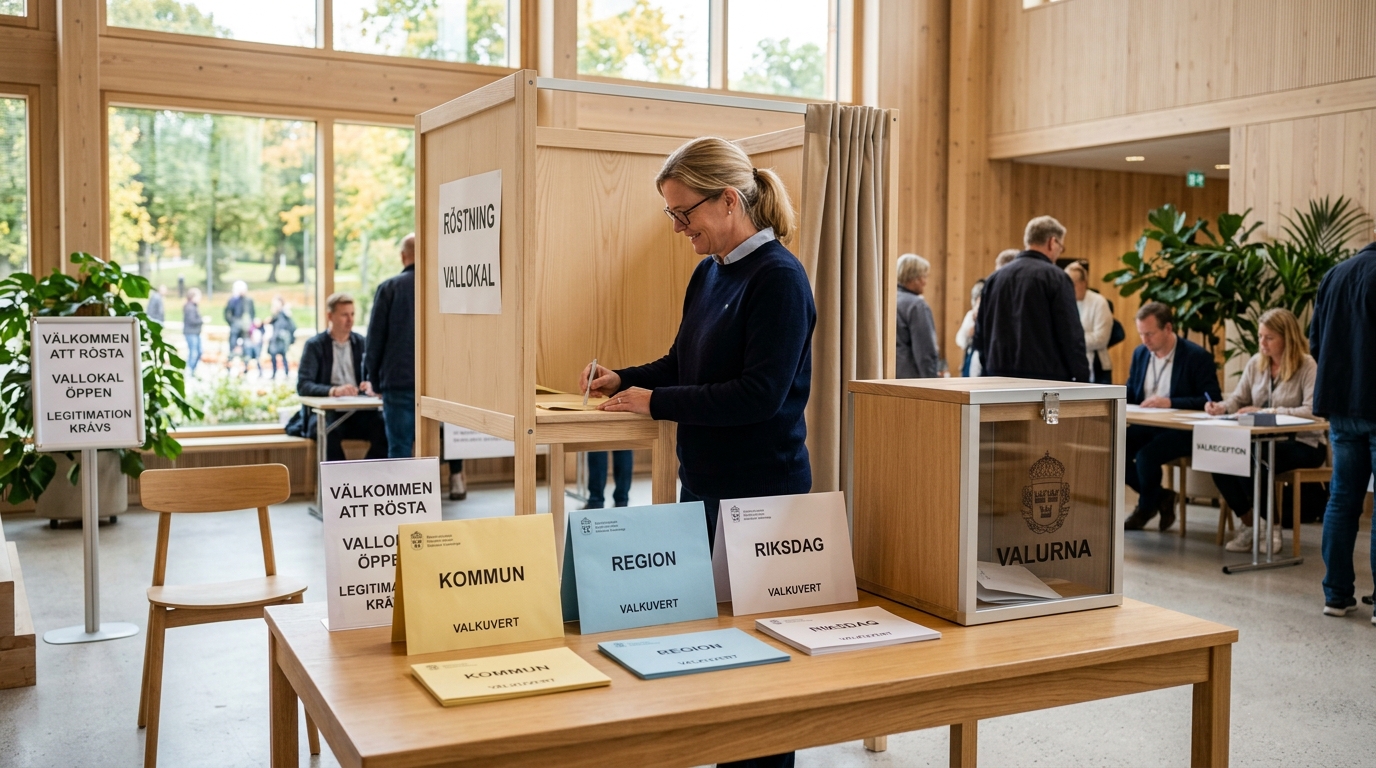
On Sunday, September 13, 2026, Sweden holds general elections to choose 349 members of the Riksdag as well as local councils across all 290 municipalities and 21 regions (Swedish Election Authority / Valmyndigheten). Advance voting runs from August 26 up until election day.
For employees and job seekers, these election issues directly intersect with household finances and job security:
- How will your net take-home pay be affected by tax policy when changing jobs or earning a promotion during the next mandate?
- What are the core arguments for and against statutory vs. collectively agreed working hour reductions (30- or 35-hour work weeks)?
- What balance between income protection and activation incentives does the reformed unemployment insurance provide?
- How do different parties intend to resolve talent shortages across public welfare and private industry?
As a strictly independent, non-partisan platform, Bytajobb takes no political stance. Our objective is to provide a balanced and factual analysis of the party platforms and their underlying rationales. All data is verified against official records from Statistics Sweden (SCB), regulatory frameworks from Skatteverket, CSN, and Sveriges a-kassor, alongside official party manifestos.
Quick Guide: Party Positions on Core Labour Market Issues
Here is an overview of how Sweden's parliamentary parties (ordered by Riksdag seat allocation) approach central labour market topics ahead of the 2026 election:
| Party | Income Tax on Labour | Unemployment Insurance (A-kassa) | Working Hour Reduction (30–35h) | Talent Supply & Immigration |
|---|---|---|---|---|
| Social Democrats (S) | Tax relief for ordinary earners, with tapering of earned income credits for high earners to finance welfare. | Raise monthly benefit cap (above SEK 34,000) so more full-time workers retain 80% replacement. | Open to phased reduction: Target 35 hours/week, primarily negotiated via bipartite agreements. | Labour market testing to uphold Swedish collective bargaining and prevent social dumping. |
| Moderate Party (M) | Enhanced earned income tax credits (up to SEK 1,000/mo relief) and adjusted state tax thresholds. | Work-first principle: Income-based benefits with step-down tapering after 100 days and strict benefit caps. | No: Damages enterprise competitiveness and public staffing; bipartite collective agreements only. | High salary threshold for non-EU work permits to prevent low-wage competition and attract talent. |
| Sweden Democrats (SD) | Lower taxes on earned income and pensions alongside reduced fuel and energy costs and benefit ceilings. | Supports income-based tapering model with strict national benefit caps for non-citizens. | No: Must not be legislated; determined by collective agreements between social partners. | High salary floor for third-country nationals; prioritise domestic matching of the unemployed. |
| Left Party (V) | Progressive tax model with higher taxes on high incomes and capital; major investments in public welfare. | Rejects tapering in A-kassa; demands permanently higher cap and abolition of illness waiting days. | Yes (Core demand): Statutory 30-hour work week (6-hour workday) with retained full salary. | Reintroduce trade union labour market testing to prevent worker exploitation and wage dumping. |
| Centre Party (C) | "Tax-free base salary" (first SEK 15,319/mo exempt from income tax) & zero payroll tax for micro-firms. | Faster tapering in A-kassa for stronger work incentives; opposes raising the qualifying cap. | No: Heavy cost burden on enterprises that would aggravate acute skilled labor shortages. | No to high salary floor: Wants easier global recruitment for IT, hospitality, and forestry. |
| Christian Democrats (KD) | Enhanced earned income tax relief; family-focused deductions and tax relief for working seniors. | Work-first principle; benefits structured as transitional insurance with tapering. | No to legislation: Increases public sector costs and damages macroeconomic growth. | Targeted high-skill attraction and robust enforcement against workplace crime. |
| Green Party (MP) | Green tax shift: Lower tax on labour and circular services; higher taxes on emissions and fossil fuels. | Broadened safety net for freelancers and gig workers; abolish illness waiting deduction. | Yes: Phased reduction to 35 hours/week with a long-term 4-day week vision. | Facilitate residency for international green specialists, researchers, and graduating students. |
| Liberals (L) | Expanded work tax credits and a long-term goal to halve the state income tax (from 20% to 10%). | Work-first principle with strict integration requirements; preserve transition focus in A-kassa. | No: Bipartite responsibility; statutory limits undermine national prosperity. | Fast-track schemes and researcher visas for international engineers and tech innovators. |
1. Income Taxes: Two Distinct Economic Approaches
The debate on earned income taxation reflects two fundamentally different perspectives on fiscal policy:
The Case for Lower Taxes on Labour (M, KD, L, SD, C)
Proponents argue that lowering income taxes increases incentives for full-time work, career progression, and educational attainment:
- The Moderates and Christian Democrats advocate expanding the earned income tax credit (jobbskatteavdrag) via Skatteverket by up to SEK 1,000/month, accompanied by deductions for working retirees and indexation of state tax brackets.
- The Liberals seek a phased halving of the state income tax rate (from 20% to 10%), contending that high top marginal tax rates penalize advanced education among engineers, doctors, and specialists.
- The Sweden Democrats prioritize lower tax on labour and pensions, funded by national benefit caps and spending reductions in other sectors.
- The Centre Party proposes a tax-free base salary (the first SEK 15,319/month exempt from income tax) and temporary payroll tax exemptions for small enterprises' first ten employees.
The Case for Redistribution & Public Financing (S, V, MP)
Proponents of redistributive tax policy argue that broad tax cuts reduce public funding needed for healthcare and education:
- The Social Democrats support tax relief for low- and middle-income workers, but propose that earned income credits taper off at higher incomes (above ~SEK 66,750/month) to ensure higher earners contribute proportionally toward core welfare services.
- The Left Party proposes progressive taxation on top incomes and capital gains to fund major expansions in public sector staffing.
- The Green Party champions a green tax shift: reducing direct tax on labour while raising taxes on environmental pollution and carbon emissions.
The Role of Municipal Tax Rates
Regardless of national policy, municipal tax constitutes the largest deduction. According to Statistics Sweden (SCB), the average total municipal tax rate in 2026 is 32.38 percent, ranging from 28.93% in Österåker to 35.65% in Dorotea – a monthly net variance of SEK 2,700 on a SEK 40,000 gross salary.
Interaktiv AI-Lönecoach
Funderar du på vilket löneanspråk du ska ange? Fyll i yrkesrollen du vill förhandla för nedan, så tar vår AI fram ett preliminärt förhandlingsunderlag baserat på SCB-statistik.
2. Social Safety Nets: Unemployment Insurance (A-kassa)
On October 1, 2025, Sweden's reformed income-based unemployment insurance took effect (Ministry of Employment / Regeringen). The debate illustrates a trade-off between transition incentives and income security:
- Proponents of Progressive Tapering (M, KD, L, SD, C):
Emphasize that qualifying via recorded income (minimum SEK 120,000/12 months) and applying scheduled benefit reductions after 100 days (Sveriges a-kassor) encourages active job seeking and minimizes duration of unemployment. The Centre Party favors accelerated tapering, while SD and the government have established benefit caps and mandatory activity requirements for social assistance. - Proponents of Enhanced Income Security (S, V, MP):
The Social Democrats argue that the qualifying monthly income cap (currently SEK 34,000) should be raised so full-time professionals retain a genuine 80% replacement rate during transitions. The Left Party and Green Party oppose the tapering mechanism and advocate eliminating illness waiting deductions, arguing that economic security facilitates sustainable job matching rather than forcing workers into mismatched positions.
Unemployment Inflow vs. Job Postings (Jan–Jul 2026)
Monthly Swedish unemployment fund applications compared to new job vacancies
Unemployment claims in July
-26.2%
24,800 (vs 33,612 in July 2025)
Job postings in July
+28.5%
39,232 (vs 30,527 in July 2025)
Matching ratio July 2026
1.6 jobs / applicant
Improved from 1.10 applicants/job in 2025
3. Working Hours: Wellbeing vs. Economic Costs
The working hours debate balances work-life balance against macroeconomic output:
- Arguments for Statutory/Agreed Reductions (V, MP, S):
- The Left Party demands a statutory 30-hour work week (6-hour workday) with full pay maintenance, arguing that productivity dividends from automation and AI should translate into leisure, gender equality, and lower sick leave.
- The Green Party advocates a phased reduction toward a 35-hour work week, with a long-term four-day work week vision.
- The Social Democrats express openness to a 35-hour target, but emphasize that working hours should primarily be negotiated sector-by-sector in collective agreements.
- Arguments Against Statutory Reductions (M, KD, L, C, SD):
- The Moderates, Christian Democrats, Liberals, Centre Party, and Sweden Democrats oppose statutory limits. They reference employer calculations showing that general reductions would reduce fiscal revenues by tens of billions and worsen staffing shortages across healthcare, schools, and industry.
4. Talent Supply & Reskilling: CSN Grants and Immigration
Parties pursue different strategies to resolve national skill shortages:
Transition Study Grants via CSN
The state career transition study grant (omställningsstudiestödet) (CSN) enables workers with at least 8 years of experience to receive up to 80% of prior income (up to SEK 5,773/week before tax in grant funding for 2026) for up to 44 weeks.
- S, V, and MP urge increased operational funding for CSN to resolve application delays.
- M and L advocate prioritizing approvals toward designated national shortage professions (such as engineers, healthcare personnel, and preschool educators).
Salary Thresholds for Labour Immigration
- M, KD, L, and SD: Support the higher salary threshold for non-EU work permits to prevent low-wage exploitation and prioritize high-skilled talent.
- The Centre Party: Opposes high salary floors, contending they obstruct recruitment for hospitality, agriculture, and tech startups.
- S and V: Call for re-establishing institutional labour market testing to ensure local candidates are considered first and collective agreement standards are safeguarded.
Try the Occupational Barometer Live!
Is your occupation in short supply, or is competition fierce? Search through over 200 professions, explore interactive maps, and see where in Sweden the job prospects are best right now.
5. Pay Transparency & The Swedish Model
Implementation of the EU Pay Transparency Directive (Directive 2023/970) highlights the interaction between EU regulations and bipartite wage formation:
- M, KD, L, and C: Paused direct statutory transposition in spring 2026 to protect the Swedish collective bargaining model and shield small businesses from administrative burdens.
- S, V, and MP: Advocate prompt incorporation of mandatory salary disclosures in job listings and bans on salary history inquiries to accelerate progress on gender pay equity. The Equality Ombudsman (DO) is conducting preparatory work.
Employer Check
Search for any company name or Swedish organization number to analyze their financials, stability, and recruitment history for free based on our unique data and official records.
Note: This service is limited to employers with job listings published on our platform.
6. Municipal and Regional Elections: 1.2 Million Public Sector Workers
Sweden's 290 municipalities and 21 regions collectively employ approximately 1.2 million professionals (SKR). Local election outcomes directly shape daily working conditions:
- Daily Rest Rules: How the EU 11-hour continuous daily rest standard (SKR / Sobona) is structured in shift schedules for healthcare and emergency personnel.
- Local Working Hour Pilots: Which regional boards sponsor pilot programs testing 30–35 hour work weeks in round-the-clock wards.
- Operational Models: The balance between private procurement and municipal management defines available employment options in your locality.
4 Actionable Steps for Your Career in 2026
Regardless of the election outcome, objective market data helps you optimize your career planning:
- Perform a Data-Driven Salary Audit: Benchmark your earnings against official statistics on Bytajobb Salary Statistics.
- Audit Prospective Employers: Use Employer Check (Arbetsgivarkollen) to examine financial stability and hiring trends before accepting an offer.
- Explore Reskilling Opportunities: Review criteria for the CSN transition study grant and identify growth fields on the Occupational Barometer.
- Set Up Automated Job Tracking: Activate Job Tracker (Jobbspanaren) for real-time notifications when new positions are posted in your region.
Conclusion: Policy Sets the Framework – You Set the Course
The 2026 election presents distinct choices for Sweden's labor market. By staying informed on party proposals and utilizing verified labor market data, you can make clear, well-founded career decisions.
👉 Explore Open Roles Across Sweden: Discover your next opportunity among over 50,000 active jobs on Bytajobb today!